
Why Small Business Sites Are Vulnerable to Hackers
If you run a small business, your website should help you generate business, look professional, and give customers a way to learn about you. Sometimes, though, you end up on a side quest building a site. Most business owners don’t want to (or can't) keep up with software updates, coding, or worry about security issues. So let’s talk about how websites get hacked and why some are more vulnerable than others.
Two main types of websites
Most websites fall into one of two categories:
- CMS (Content Management System) sites, most commonly WordPress.
- Static, made up of fixed HTML, CSS, and JavaScript files.
While both approaches have their uses, they operate very differently from a security standpoint.
Why CMS-based sites get hacked more often
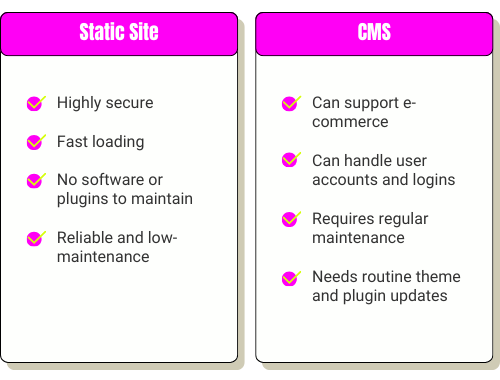
CMS sites offer a lot of flexibility, but...it’s complicated. Multiple components need to work together: user login systems, databases, plugins, themes, user permissions, and the CMS software itself. Each of these pieces is a potential target for hackers.
When you hear about a site being hacked, it’s commonly due to:
- outdated plugin(s) or theme(s)
- weak passwords
- vulnerabilities in the CMS
- malware injected through an exploit
- brute-force automated login attempts
Don't take it personally. Hackers are usually not targeting a specific small business. But they use automated tools that scan the internet for known weaknesses in CMS platforms. The more complex a site is, the more possible weak points exist.
According to a report from reporting from website-security and malware-removal company Sucuri - most compromised CMS-based sites involved outdated or vulnerable plugins, themes, or software rather than flaws in the core CMS itself. Since WordPress is by far the most widely used CMS on the internet, it naturally appears most frequently in infection reports. And to be clear, every website platform is susceptible to some level of risk - even static sites - but static sites simply have far fewer potential attack points.
Why static sites are harder to hack
Static sites are fundamentally simpler. They don’t have login systems, dynamic code, or databases. They’re essentially just files delivered to the browser. With fewer moving parts, there are fewer places for hackers to break in. You’re not dealing with constant updates, plugin vulnerabilities, or version mismatches - and that simplicity reduces risk.
Which one is right for your business?
A CMS might be better if you need:
- frequent content updates via an admin dashboard
- a blog you update yourself
- e-commerce
- user accounts
- advanced third-party plugins or integrations
A static site might be better if you need:
- a fast, secure, and worry-free website
- a site where content changes occasionally, but doesn’t need dynamic features
- simple informational pages (services, about, contact)
- minimal maintenance and fewer long-term updates
For many small businesses - including local services, trades, restaurants, consultants, and independent professionals, a static site is not only simpler, but significantly safer.
Non-technical security advice for CMS users
If you do use a CMS, you can reduce risk by:
- keeping plugins and themes updated
- uninstalling unused plugins
- scheduling daily backups
- using strong, unique passwords
- using quality hosting that doesn't nickel and dime you
TL;DR
Both static and CMS-based sites have advantages depending on your needs. There’s no single correct answer for everyone - only the best fit for your situation. If your site is purely informational and low-maintenance, a static site can save you time, stress, and risk. If you need more functionality and flexibility, a CMS can make sense as long as it’s regularly maintained.
Why I Only Build Static Sites (And Handle All the Updates for You)
If you’re considering a new site and want something secure, fast, and stress-free, I specialize exclusively in static websites for small businesses. I don’t build CMS sites like WordPress - and that’s intentional. Static sites are more secure, require fewer updates, and don’t expose your business to the same hacking risks. And here’s the key point - whenever you need edits, changes, or updates to your site, I take care of them for you.
You don’t have to log in, manage software, or touch any code. If you’d like to explore my plan options and find the best fit for your business, I’d be happy to help.